
Part I - Embodied Connection to Your Soul’s Path
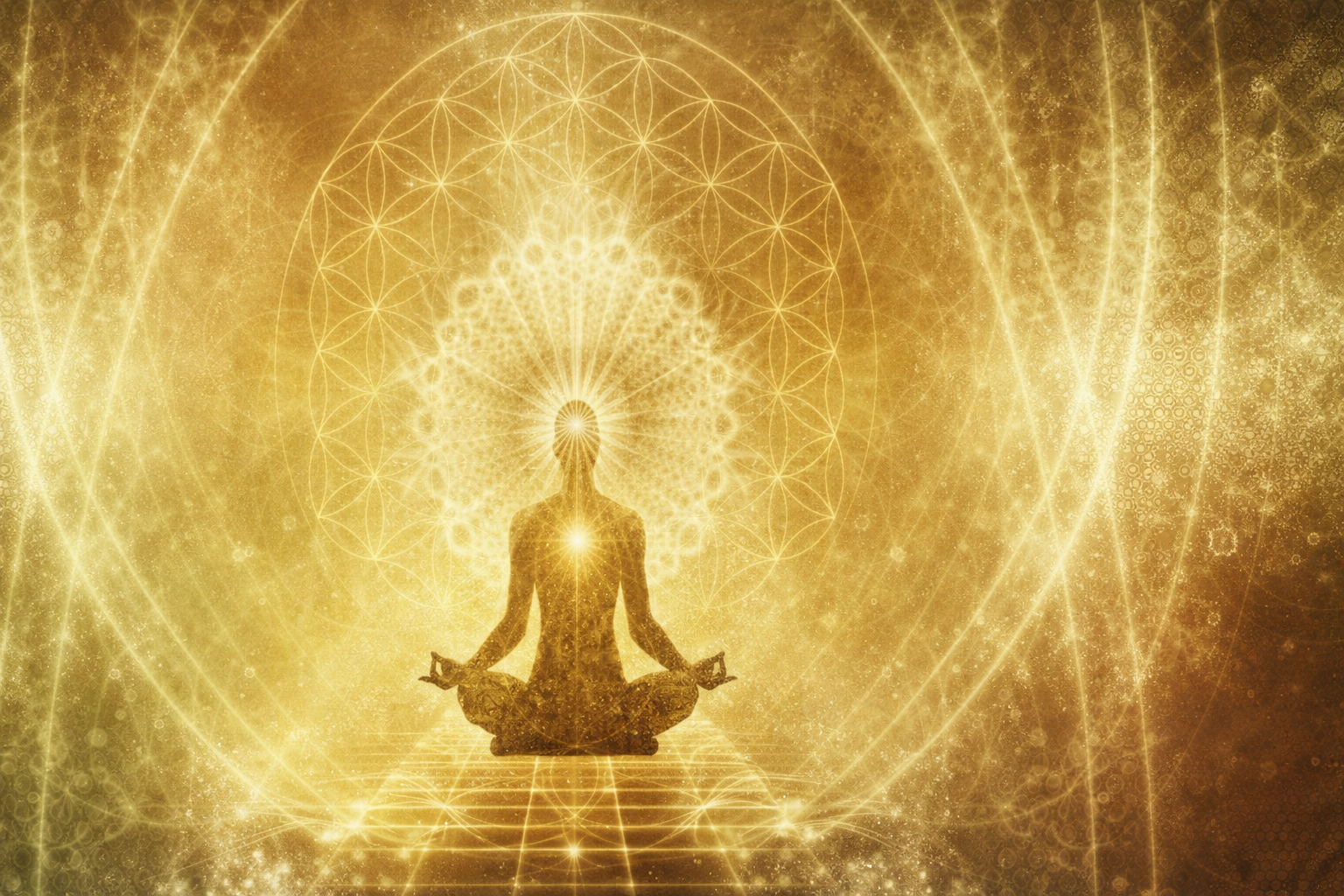
Golden neural pathways and sacred geometry symbolise the intelligence of the nervous system, reminding us that the soul’s path is not accessed through thought alone, but through felt presence, breath, and lived sensation.
Living Your Truth Through the Body of Now
Your soul’s path is not a distant mountain you have to climb someday when you’re finally ready, healed, or worthy enough.
It’s already here.
It’s in the way your chest tightens when you say yes but mean no.
It’s in the warmth that spreads through your body when you’re doing something aligned.
It’s in the quiet ache you feel when you betray a truth you can’t un-know.
Your soul’s path is not an abstract concept; it’s a lived, moment-to-moment relationship with yourself.
You don’t discover it by escaping your life.
You discover it by inhabiting your life — fully, honestly, in your body.
And that’s where embodiment comes in.
Because without embodiment, even the most beautiful spiritual insight is just another idea floating above your nervous system’s reality. You can know what’s true and still keep living out the old pattern. You can understand your wounds and still repeat the same relationship, the same burnout cycle, the same self-abandonment.
Insight without embodiment becomes another loop.
Embodiment is what turns awareness into change.
It’s what turns a soul calling into a lived path.
The Myth of a Path That’s Somewhere Else
So much of the spiritual and self-help world sells a picture of “purpose” as something out there — a single life mission you have to decode, a higher calling waiting in the future, a version of you who is always one course, one breakthrough, one healing session away.
In that model, your current life becomes a problem to fix. Your body becomes a project. Your emotions become obstacles. Your humanity becomes something to transcend.
But what if your soul’s path isn’t hidden in some future, perfected timeline —
but in the way you’re breathing right now?
What if it’s not a thing you “find”,
but a truth you remember and embody, one decision, one sensation, one breath at a time?
Your body is not blocking your soul.
Your body is the access point.
Every time you override it, you step off the path.
Every time you come back to it, you step back on.
What Embodiment Really Means (And What It Doesn’t)
Embodiment isn’t about looking a certain way, moving perfectly, or ticking off some checklist of “spiritual habits”.
It’s not about always feeling calm or regulated.
It’s not about never getting triggered.
It’s not about being some serene, untouchable version of yourself.
Embodiment is much more honest than that.
To be embodied is to be present inside your own experience, instead of hovering above it, judging it, narrating it, or trying to bypass it.
It means you are willing to feel what you feel, in real time — the tension, the grief, the anger, the fear, the joy, the tenderness — and stay with it long enough for your body to complete what it’s been trying to do all along.
It means your body is not an afterthought to your healing; it’s the central terrain.
Embodiment is:
The way you notice your shoulders creep up when you’re people-pleasing, and consciously soften them as you speak your truth.
The way you feel your stomach drop when you’re about to abandon yourself, and choose a different response.
The way you meet a wave of sadness, not with “What’s wrong with me?”, but with “Of course this hurts. I’m here with you.”
It’s not glamorous work most of the time.
It’s slow, sometimes uncomfortable, deeply intimate work.
But it’s the only work that truly changes anything.
How We Get Disconnected From Our Bodies
No one arrives at adulthood feeling perfectly safe in their body.
We are taught — sometimes gently and sometimes violently — that what we feel is too much, too inconvenient, too dramatic, too sensitive, too irrational, too “weak”, too intense.
We learn to:
Tighten instead of cry.
Smile instead of say no.
Work instead of rest.
Reason instead of feel.
Perform instead of be.
We internalise messages like:
“Don’t be so emotional.”
“Don’t make a scene.”
“Be strong.”
“Stop overreacting.”
“Other people have it worse.”
“Just get on with it.”
So we do.
And gradually, the nervous system learns that feeling equals danger or shame.
The safest option becomes disconnection.
We leave the body and take up residence in the mind — analysing, rehearsing conversations, telling stories about who we are and what we’re allowed to want. We can spend years trying to fix ourselves from the neck up.
But the unfelt parts of us don’t vanish.
They sink deeper — into muscle, fascia, breath patterns, posture, digestion, sleep.
Your history doesn’t disappear; it settles.
It settles in a jaw that never quite unclenches.
In a gut that never fully relaxes.
In a breath that doesn’t go all the way down.
In a nervous system that stays slightly braced, just in case.
This is why you can “know better” and still feel stuck.
Your body is running an older script.
Trauma, Loops, and the Body’s Need for Completion
When we talk about trauma here, we’re not only talking about catastrophic events. We’re talking about anything that was too much, too fast, for too long — without enough support or safety to fully process it.
Trauma isn’t just the story of what happened.
Trauma is the unfinished response trapped in the body.
The words that never came out.
The tears that had to be swallowed.
The “no” you weren’t allowed to say.
The push, the run, the scream, the shake that never got to happen.
The body holds that incomplete impulse as tension, numbness, anxiety, shutdown, overreaction, or chronic vigilance.
Every trigger isn’t your body “misbehaving” — it’s your body asking:
“Can we finally finish this now?
Can we feel this?
Can we complete this?”
If you answer that with more suppression, bypass, or self-judgement, the loop continues.
This is why embodiment is non-negotiable.
You can’t re-programme what your body hasn’t had permission to feel and complete.
The Nervous System: Where Safety Meets Soul
Your soul can’t fully land in a body that feels like a war zone.
If your nervous system is constantly in fight, flight, freeze or fawn, the wisdom you’re asking for has nowhere stable to root.
Embodied connection isn’t just about “being spiritual in your body.” It’s about learning how to create enough physiological safety that your deeper knowing can surface without being drowned by survival strategies.
That might look like:
Taking three honest breaths before you answer a message that spikes your chest.
Noticing your heart rate jump in a conversation, and pausing instead of pushing through.
Recognising that your “I don’t care” shutdown is actually a protective freeze, not your true indifference.
Realising that your constant busyness is not a personality trait, but a nervous system strategy to avoid feeling.
When you start to see your body’s reactions not as flaws, but as attempts to protect you, compassion can enter the room.
And compassion is regulation.
You can’t shame a nervous system into safety.
You can only meet it.
The Body as Oracle: Learning Your Inner Yes and No
The more embodied you become, the more obvious your soul’s path feels.
Not because someone told you what your purpose is,
but because your body stops lying for you.
You can feel when something is aligned:
There’s a sense of expansion, warmth, presence. Your breath deepens. Time feels different — not rushed or tight, but clear. There’s a grounded “yes” that doesn’t need convincing.
That is your inner oracle.
We often ask the mind:
“What should I do?”
“How do I choose?”
“What’s the right path?”
But the body answers more honestly, and much faster.
Embodied connection is about building a relationship with those signals. Not treating them as random noise, but as guidance.
Over time, your body will show you:
Which people your energy actually rests with.
Which spaces drain you.
Which projects are true, and which are ego distractions.
Which choices are old patterns trying to repeat themselves.
Your soul doesn’t speak in spreadsheets.
It speaks in resonance.
From Insight to Integration: Why Embodiment Is the Missing Step
Many people reach a point where they “understand” their patterns:
“I know this comes from my childhood.”
“I know I’m repeating this dynamic.”
“I know I’m afraid of being seen.”
Insight is valuable. It can be a doorway. But without embodiment, insight often becomes another way to watch yourself from the outside, instead of actually changing from the inside.
You can see the story and still remain inside it.
Embodied connection asks a different question:
Not “Why am I like this?”
but
“What is my body feeling right now, and how can I be with it differently?”
The moment you bring your awareness into the body — not as an observer judging, but as a presence staying — the loop begins to unravel.
Instead of trying to override your reactions with “positive thinking,” you learn to:
Notice the tightening in your throat when you want to speak and don’t.
Feel the knot in your stomach when you’re betraying yourself.
Stay with the heat of anger until it reveals the boundary underneath.
Let the grief move like a wave instead of locking it away again.
Every time you do this, your nervous system gets new information:
“It’s safe to feel this now.
It’s safe to be here.
I don’t have to leave myself.”
That’s integration.
That’s change.
Daily Pathways Into Embodied Connection
Embodiment doesn’t require hours of practice or elaborate rituals. It asks for sincerity, consistency, and a willingness to be honest with yourself in small moments.
Here are a few pathways, written as living invitations rather than rigid techniques:
Breath as a Bridge
At any point in your day, pause.
Feel where your breath naturally wants to go. Is it stuck high in the chest? Is it shallow and fast? Does it disappear when you read that email, open that app, think of that person?
You don’t have to force anything.
Just become aware.
Then invite one slow, generous exhale. Let your shoulders soften a fraction. Let your jaw unclench. Let your tongue fall from the roof of your mouth.
That single exhale is a doorway back into your body.
It says, “I’m here. I’m coming back.”
Sensation Before Story
Instead of asking “What’s wrong with me?” when you feel off, ask:
“What sensations are here, right now?”
Maybe it’s a buzzing in your chest, a heaviness in your limbs, a hollowness in your belly, pressure behind your eyes.
Name them. Not as a diagnosis, but as a description.
“I notice heaviness.”
“I notice tightness.”
“I notice emptiness.”
This simple act of witnessing sensation without instantly turning it into a narrative is one of the most powerful somatic practices you can do. It allows your body to be felt without being hijacked by interpretation.
Tiny Acts of Truth
Embodied connection isn’t just what you feel on the mat, the meditation cushion, or the beach. It’s what you choose in the mundane.
It’s the moment you reply to a message hours later instead of instantly, because your body needed space.
It’s the time you say, “Actually, I’m not available tonight,” even though you’re afraid they’ll be disappointed.
It’s the boundary you hold when everything in you wants to collapse and just say yes to keep the peace.
Every small act of truth is a brick in the path of your soul’s journey.
The Cost of Not Embodying Your Soul’s Path
It’s worth naming this clearly:
When you don’t listen to your body, it doesn’t quietly give up.
It speaks louder.
What starts as subtle:
mild anxiety
low-grade tension
numbness
random fatigue
can eventually become:
chronic stress
burnout
sleep issues
digestive disorders
mysterious aches and pains
cycles of “I’m fine / I’m overwhelmed”
deep disconnection from joy and aliveness
We’re not saying everything physical has a single emotional cause — life is more complex than that. But we are saying your body will keep trying to get your attention in whatever way it can.
When you ignore the whispers, the body raises its voice.
Embodiment isn’t a luxury; it’s how you stop your life revolving around unaddressed patterns, unexpressed truths, and unprocessed experiences.
Embodied Connection Changes What You Attract and Create
As you become more embodied, subtle but profound shifts start happening in your external life.
You may notice:
You tolerate less of what drains you and more of what nourishes you.
Relationships that required you to self-abandon become unbearable to maintain.
Work that’s built on constant adrenaline and overextension starts to fall away.
You’re drawn to environments, people, and rhythms that let your nervous system exhale.
You start creating from a place of resonance, not compensation.
This is not always comfortable. Some identities fall apart. Old roles no longer fit. Certain dynamics collapse. Parts of your life that were built on your disembodiment can’t survive your embodiment.
But what emerges on the other side is life that fits you from the inside.
Less acting, more being.
Less chasing, more aligning.
Less forcing, more responding.
This is your soul’s path becoming visible — not as a single “job” or role, but as a way of moving through the world that matches who you actually are.
Self-Compassion: The Nervous System’s Native Language
One thing is essential: if you’re going to walk an embodied path, you cannot do it through self-attack.
You will have days where you slip back into old patterns.
Where you override your body.
Where you say yes when you meant no.
Where you scroll instead of feel.
Where you numb instead of breathe.
That doesn’t mean you’ve failed.
It means you’re human.
Your nervous system is not a computer to reprogram once and have it stay fixed. It’s a living system learning what safety, truth, and alignment feel like — often for the first time.
Each time you notice yourself leaving your body and gently come back, you’re building a new pathway.
Each time you meet a trigger with curiosity instead of shame, you’re re-writing an old script.
Each time you say, “Of course I coped this way before. Now I’m choosing differently,” you are anchoring your soul more deeply into your life.
Compassion isn’t softness for its own sake. It’s the only state from which genuine regulation and transformation can happen.
Your body will not fully open to someone who keeps attacking it — even if that someone is you.
This Is the Beginning, Not the End
Embodied connection to your soul’s path is not a one-time event. It’s not a single ceremony, a single retreat, a single breakthrough.
It’s a relationship you keep tending.
With each breath.
Each sensation.
Each honest choice.
Each moment you choose to stay with yourself instead of leaving.
Over time, your body becomes less of a battleground and more of a sanctuary.
Your nervous system becomes less of a prison and more of a guide.
Your life becomes less about survival and more about aligned expression.
This is Part One of The Embodied Path Trilogy, and it’s foundational for everything that follows.
From here, the journey continues into:
Part II – Embodied Awareness: learning to track emotion, sensation, and energetic signals with clarity and presence, so you can realign from the inside out.
Part III – Embodied Alchemy: transforming triggers and trauma loops into portals of healing, completion, and soul reclamation.
But none of that means anything if you’re not here.
In your body.
In this breath.
In this moment.
Your soul’s path isn’t out there, waiting to be unlocked by the next external thing.
It’s already alive in you.
Every time you come home to your body,
you come home to your path.
What follows will deepen into awareness, regulation, and integration —
always through the body, never bypassing it.
For now, pause. Feel. Breathe.
When you’re ready, the next transmission will be dropping here in the Resonance Journal soon.
In the meantime, come flow with us on socials: